
 By Naomi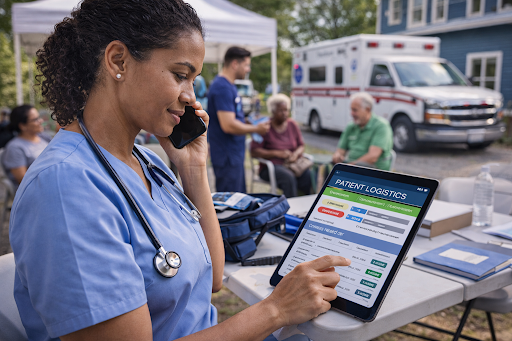
When people talk about supply chains breaking down, they usually picture cargo ships, warehouse robots, or port congestion. But in 2026, one of the most consequential supply chains in the United States is not moving goods—it’s moving care. And the most vulnerable link in that chain is not a machine. It is a person.
Healthcare, at its operational core, is a logistics problem. Hospitals rely on scheduling algorithms. Home health agencies use route-optimization software. Electronic health records generate real-time dashboards that track patient status like parcels in transit. The infrastructure looks impressive from the outside. But none of it means much if the right person does not show up at the right door, at the right time, with the right skills.
The Last Mile Problem in Patient Care
In traditional logistics, the “last mile” is the most expensive and most difficult segment of any delivery route—the final stretch from a distribution hub to the customer’s front door. In healthcare, the Direct Care Worker (DCW) is that last mile. They are the trained professional who administers medication reminders, assists with daily living activities, monitors behavioral changes, and builds the kind of trust that keeps patients stable and out of emergency rooms.
The numbers reflect the stakes. According to the U.S. Bureau of Labor Statistics, the direct care workforce is projected to add more than one million new jobs through 2032, making it one of the fastest-growing occupational categories in the country. Demand is being driven by an aging population, a policy shift toward community-based care, and the ongoing pressure to reduce costly hospital readmissions. Yet workforce shortages remain severe, and turnover rates in the sector routinely exceed 60 percent annually.
Certification as a Supply Chain Input
The healthcare industry has responded to this pressure in two ways: raising the bar for entry-level qualifications and accelerating the pipeline for new talent. Both strategies are now reshaping how workers prepare for and enter the field.
Regulatory requirements for direct care roles vary by state, but the general trend is toward more rigorous competency verification. Workers are expected to demonstrate knowledge of patient rights, infection control, emergency response protocols, and ethical decision-making—sometimes before they set foot in a client’s home.
In the complex web of 2026 healthcare logistics, efficiency is often measured in data points, but success is measured in human outcomes. The Direct Care Worker (DCW) functions as the critical “last mile” of this infrastructure, providing the hands-on support that automated systems cannot replace. However, as the regulatory environment tightens, the barrier to entry for these roles has become more technical. To maintain a steady supply of qualified talent, the industry is leaning on digital training assets. Utilizing a comprehensive DCW practice test has become the standard for candidates looking to verify their clinical and ethical knowledge before entering the field, ensuring the resilience of our community care systems.
What a Resilient Care Supply Chain Actually Looks Like
Logistics professionals often talk about “system resilience”—the ability of a supply chain to absorb disruption and recover quickly. In healthcare, resilience looks like a certified DCW who can step into a new assignment on short notice, already fluent in the protocols and expectations of the role. It looks like an agency that can confidently place workers because their preparation has been validated, not assumed.
The parallel to industrial supply chain management is not accidental. Healthcare administrators and workforce planners are increasingly borrowing concepts from operations research: talent pipelines, throughput modeling, credential verification as a quality checkpoint. The idea that human readiness can and should be systematized is no longer controversial. It is operational best practice.
For those looking to understand the formal credentialing framework that governs direct care roles at the federal level, the Centers for Medicare & Medicaid Services (CMS) nurse aide training and competency evaluation standards provide the regulatory foundation that many state-level DCW certification programs are built upon.
Conclusion: The Most Important Worker in the Chain
The healthcare supply chain of 2026 is sophisticated, data-driven, and under enormous pressure. But its ultimate performance is judged not by throughput metrics or cost-per-visit dashboards. It is judged by whether a person with complex needs received attentive, skilled, compassionate care from someone who was genuinely prepared to provide it.
That someone is the Direct Care Worker. And in a system this consequential, preparation is not optional. It is the foundation everything else is built on.