
 By Naomi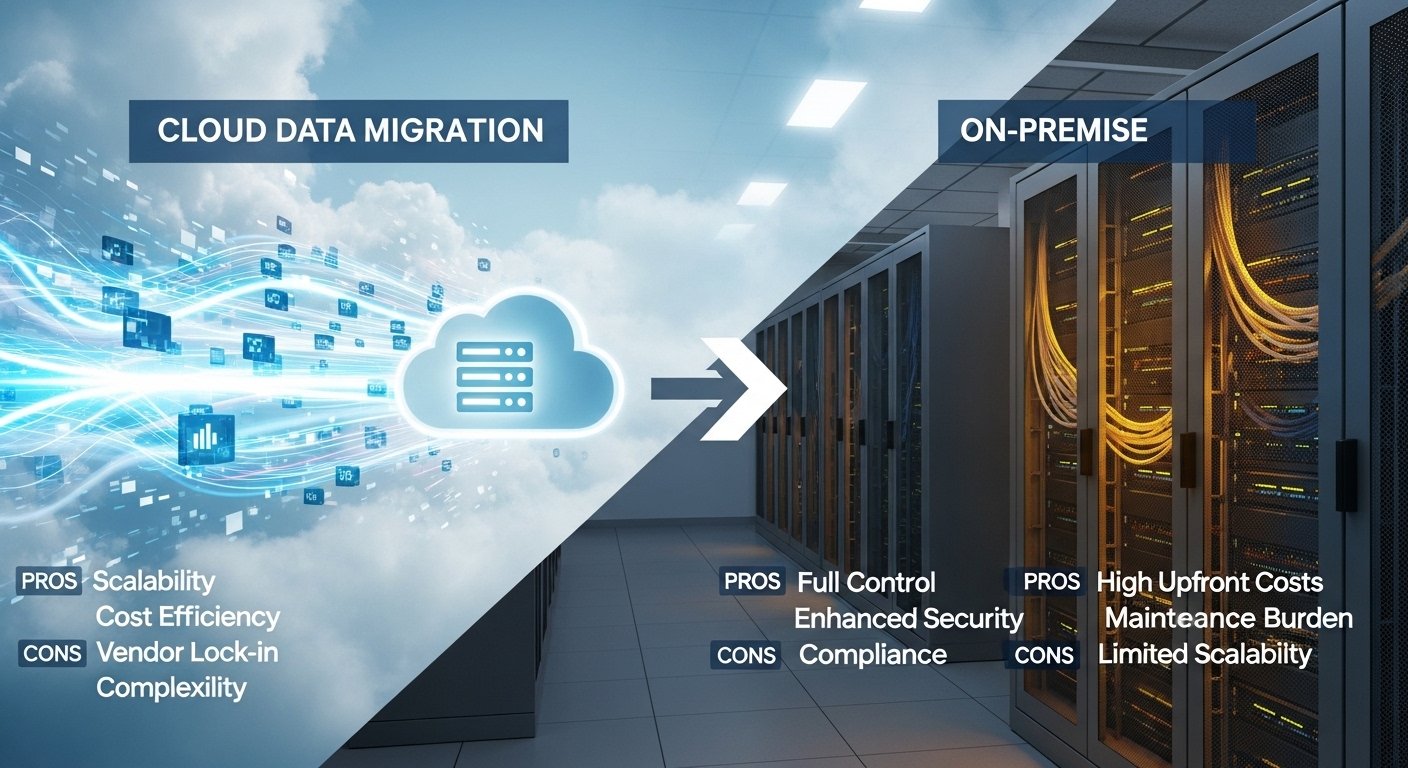
For most enterprises, the decision isn’t whether to modernize the data estate, but where to host it. Should you migrate workloads to the cloud or keep them on-premises? Each path entails trade-offs in terms of cost, speed, security, governance, and talent.
Making the right call requires more than a price comparison—it demands a clear view of business goals, regulatory constraints, and operational realities. This guide breaks down the pros and cons of cloud vs. on-premises solutions, offers a hybrid perspective, and shares a simple decision framework that you can use in conjunction with an experienced data migration services company.
Cloud data migration: the upside
1) Speed to value
Cloud platforms compress timelines. Managed services (warehouses, lakehouses, streaming, and ML) remove heavy lifting, allowing teams to ingest, transform, and analyze data faster. Provisioning new environments takes minutes instead of weeks, enabling rapid pilots and incremental delivery.
2) Elastic scale
Demand is spiky—driven by quarter-end reporting, seasonal peaks, and viral campaigns. Cloud elasticity enables you to scale up for bursts and scale down afterward, paying only for what you actually use. That flexibility is hard to replicate in fixed on-prem capacity.
3) Innovation flywheel
Major cloud providers ship constant enhancements—query engines, vector databases, governance tooling, and AI assistance. Adopting these capabilities early can deliver competitive differentiation without a heavy maintenance burden.
4) Reliability and resilience
Multi-AZ/region architectures and managed SLAs can improve availability and recovery times. Modern observability stacks offer richer telemetry and proactive alerts.
5) Predictable operations
Patching, firmware, and rack-and-stack vanish from your backlog. Platform teams focus on data products, governance, and FinOps rather than hardware lifecycle.
Cloud tradeoffs to watch
1) Cost sprawl
Elasticity cuts both ways. Poor tagging, chatty queries, and orphaned resources can inflate bills. FinOps disciplines—budgets, alerts, right-sizing—are mandatory.
2) Data egress & gravity
Moving large datasets out of the cloud can be expensive. If critical systems remain on-prem, data gravity can introduce latency and integration complexity.
3) Regulatory constraints
Certain jurisdictions and sectors impose data residency, sovereignty, or encryption requirements that narrow cloud options or demand extra controls.
4) Vendor lock-in
Proprietary services speed delivery but can raise exit costs. Designing with portable patterns (open formats, containers, abstraction layers) mitigates risk.
On-premise: the upside
1) Fine-grained control
You dictate hardware, network, and security configurations, which can be crucial for specialized workloads, low-latency trading, or strict sovereign controls.
2) Predictable fixed costs
Capex-heavy models can suit organizations that prefer amortization over variable opex. For steady, high-throughput workloads, owned infrastructure can be efficient.
3) Data locality
Keeping data physically close to plant floors, labs, or edge sites reduces latency and simplifies certain compliance narratives.
On-prem tradeoffs to watch
1) Slower time-to-market
Procurement cycles, facility constraints, and manual provisioning extend timelines. Upgrades are periodic and disruptive.
2) Scalability ceilings
Capacity is finite. Overbuilding wastes capital; underbuilding throttles growth. Seasonal or unpredictable spikes are difficult to handle.
3) Talent and maintenance load
Skilled infrastructure and platform engineers are required to maintain parity with cloud reliability and security practices. Patching, replacements, and audits consume bandwidth.
4) Innovation lag
New analytics and AI capabilities arrive to on-prem later (if at all), limiting how quickly teams can experiment.
The hybrid middle ground
For many enterprises, when choosing between rehosting, replatforming, and refactoring cloud migration approaches, the rational answer is “both.” A hybrid architecture keeps regulated or low-latency workloads on-prem while shifting analytics, AI, and burst jobs to the cloud. Practical patterns include:
-
Cloud for analytics; on-prem for systems of record: Replicate data via CDC for near-real-time analytics while operational systems remain in place.
-
Edge + cloud: Process time-critical signals locally and aggregate them to the cloud for training and cross-site insights.
-
Phased migration: Start with non-critical domains, build platform muscles, then move core workloads as governance matures.
A seasoned data migration services company can help define the landing zones, network topology, security baselines, and data contracts that make hybrid work without chaos.
Decision framework: five questions to settle first
-
What business outcome are you buying?
Faster insight? Lower cost-to-serve? AI enablement? Rank outcomes and tie them to KPIs (e.g., report latency, ML cycle time, cost per query).
-
What are the guardrails?
Map regulations (residency, encryption, retention) and risk thresholds (RTO/RPO). These constraints narrow options quickly.
-
Where is your talent today?
Do you have cloud FinOps and platform skills, or strong in on-prem engineering? Plan for training or managed services accordingly.
-
How bursty is demand?
Highly variable workloads favor cloud elasticity; stable, predictable loads might justify an on-prem investment.
-
What integrations anchor you?
Systems that cannot move (mainframe, factory SCADA) create gravity. Decide whether to co-locate analytics or offset with robust pipelines and caching.
Migration approach: reduce risk, prove value
Whether you choose cloud, on-prem, or hybrid, approach migration as a product, not a one-time project.
-
Baseline first. Measure current costs, performance, and reliability. No baseline, no ROI.
-
Thin slices. Migrate by domain (e.g., finance analytics, marketing attribution), delivering end-to-end value in weeks.
-
Data contracts. Define schemas and SLAs between producers and consumers; validate with automated tests.
-
Observability from day one. Track job success, freshness, cost per workload, and user adoption.
-
Security by default. Least privilege, encryption, key management, and audit trails; document how controls meet compliance.
-
FinOps or bust. Tagging, budgets, rightsizing, and cost reviews—especially critical in cloud.
A capable data migration services company will bring reference architectures, playbooks, and accelerators to compress timelines while maintaining tight governance.
Cost realism: apples to apples
Comparing cloud vs. on-prem costs requires a holistic view:
-
Cloud: compute, storage, network (egress), managed service fees, support tiers, and FinOps overhead.
-
On-prem: hardware, facilities (power/cooling), networking, software licenses, depreciation, spares, staff, and maintenance contracts.
Add opportunity cost: the value of faster experimentation and delivery. If cloud unlocks two new analytics use cases per quarter, that revenue or savings should be factored into the equation.
KPIs that prove the decision
-
Performance: query latency, throughput, SLA attainment.
-
Reliability: incident minutes, RTO/RPO achieved.
-
Cost: unit cost per report/job, cost per active user, waste reclaimed.
-
Productivity: time to provision environments, analyst hours saved, model cycle time.
-
Adoption: MAUs of analytics tools, stakeholder satisfaction.
-
Compliance: audit findings closed, policy violations prevented.
Report these KPIs quarterly to demonstrate value realization and guide next steps.
Conclusion
There is no universal winner in “cloud vs. on-prem”—there’s only the architecture that delivers your outcomes with acceptable risk and cost. Cloud shines for speed, elasticity, and innovation. On-prem delivers control, locality, and predictable capex.
A hybrid often bridges the gap. Whichever route you choose, anchor decisions to business KPIs, enforce governance from day one, and instrument relentlessly. Partnering with an experienced data migration services company turns migration from a risky leap into a measured, value-driven journey—one that compounds advantages long after cutover.